

Nexoria
Get started

AI chatbots for your website: answers from your company knowledge

A Nexoria chatbot answers visitors' questions on your own website using the knowledge of the workspace it is assigned to. It cites the source for its answers, books appointments with a confirmation email on request, and hands enquiries that need personal attention over to a member of staff. On request, it can also reach databases, calendars, CRM, e-commerce, ERP and your own API via connectors. It is included in the core product, and it sees only what its workspace shares.

Compared with Copilot Studio · Website bot In the example, the website chatbot answers questions with sources, records an appointment request and hands the conversation over to a team member.

Chatbots in everyday work

Helpful answers, right on your website.

A chatbot uses assigned company knowledge and supports visitors through to the right next step.

Compared with Copilot Studio · Website bot

Answer website questions

A chatbot answers on your website using the knowledge of its assigned workspace and cites the relevant sources.

Still image: Website chatbots.

Watch video: Website chatbots

INTEGRATE YOUR TOOLS

Customer service: what you can work with.

The website widget uses your knowledge base. We agree on external calendars, CRM and your own interfaces as part of the project.

Custom integrations depend on the interface and permissions of your system.

WHAT THIS LOOKS LIKE DAY TO DAY

Make your knowledge available in conversation.

Assign the chatbot to a workspace knowledge base. It answers questions based on shared content with source references; you maintain the underlying documents in the knowledge collection.

  • Visitor question
  • Knowledge base
  • Response
  • Source
Answer questions
Visitor question
Knowledge base
Response
Prepare a reply↗
Functional diagram · Sample data

This is Nexoria

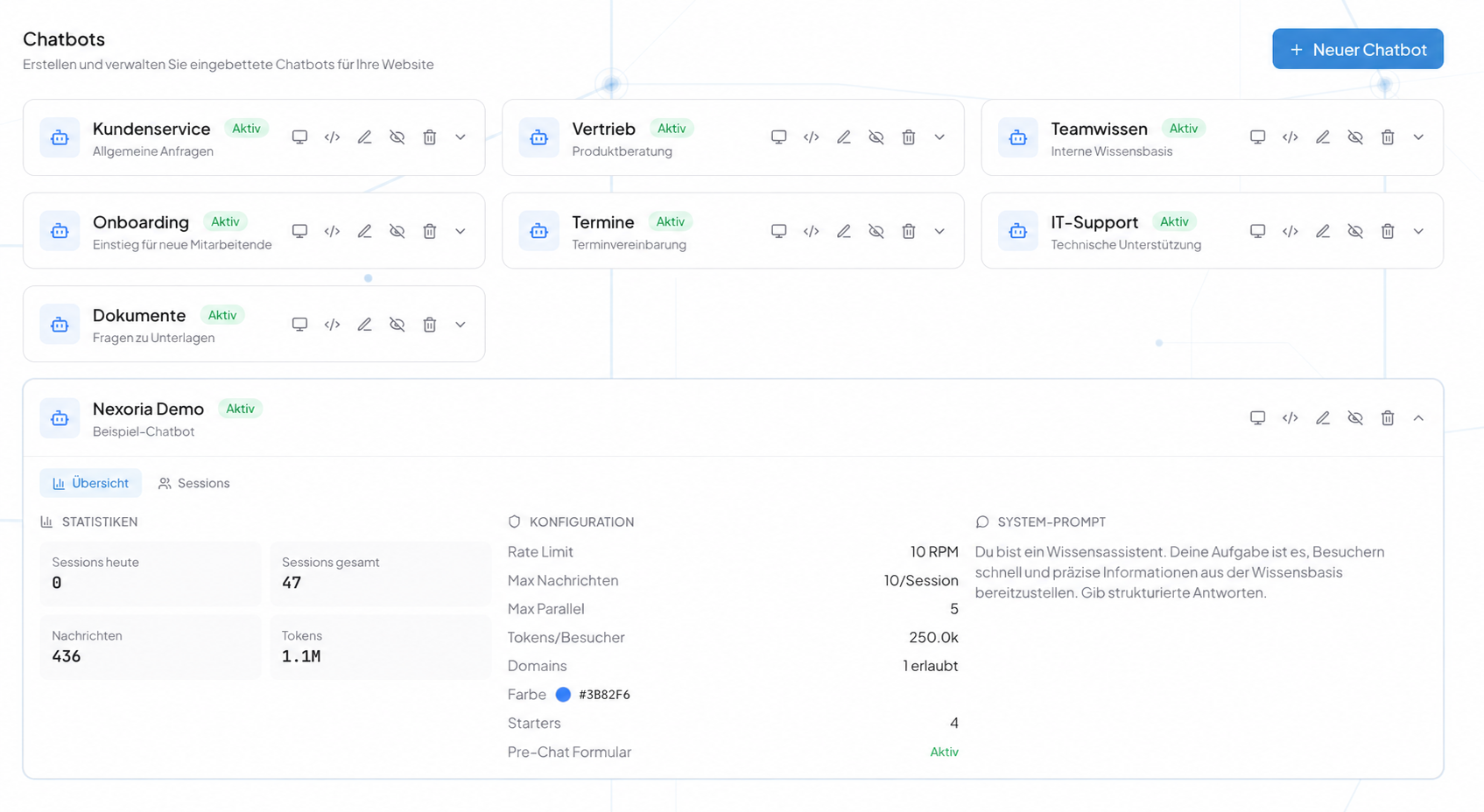
Your chatbots. At a glance.

Chatbot management with neutral demo names. Names and labels have been adapted for publication.

Chatbot management with neutral demo names. Names and labels have been adapted for publication.
Real product view · Names adapted for publication
Customer service: all the detailsPrerequisites, background and frequently asked questions

Definition

Definition

Chatbots answer visitor questions on the company's own website using the knowledge of the workspace assigned to them.

The chatbot is therefore the outward-facing side of the same knowledge base that is used in-house by Nex and the Document search as well. Whoever decides what a bot may see does so in the same place as for employees, namely in the Workspace. There is no second permissions system just for bots.

Problem

The problem

Replaces chat tools such as Intercom or Tidio with a bot that answers from your own company knowledge.

A chat window on a website is quickly installed. The work starts afterwards, because someone has to teach the tool what it is allowed to say. This is usually done with specially written text snippets that have to be maintained a second time alongside the maintained company knowledge. As soon as something changes, it changes in one place and not in the other.

The second breaking point is the question nobody anticipated. A tool that answers from prepared snippets cannot answer it and sends the person asking to the contact form. Yet the answer is often already available in-house, just in a document rather than in a chat snippet.

Key point

The bot answers from your content

This section explains the core of the service, which is why it goes into detail. The difference lies not in the chat window but in where the text that appears in it comes from.

Not from snippets, but from your content

A Nexoria chatbot is not given a list of pre-written answers. It is given a workspace, and with it that workspace's knowledge base: the documents stored there, the content held there, the structured data. It can say whatever is stated there. If a document there is changed, the answer changes with it, without anyone having to update a chat snippet.

Technically, this is the same approach that underlies search and Nex: the answer is generated from retrieved passages of your own content. The term for this is RAG, and the glossary page describes it neutrally, without reference to any product.

The source reference is part of it

The bot provides the source reference with its answers. This is the basis for making such an approach available externally: the reference to the passage in your own content makes an answer verifiable. This lets you check the language model's answers directly against their source. AI answers may contain errors.

The workspace is the boundary

Included in the core product; a chatbot receives only the knowledge of the workspace assigned to it.

This is why a bot for the website and a bot for the factory floor are two bots and not one with two roles. Each of them is tied to the knowledge space it is allowed to see. The separation lies not in its instructions but one level deeper, in storage.

Handover to your team

For enquiries that need a personal response, the bot hands over to a member of staff. The component's outputs therefore include not only answers and booked appointments but also the handovers.

How it works

How a chatbot is created

  1. Step 1

    Create a bot and assign it to a workspace

    A new bot is given a name, a template, a greeting, quick replies and its system prompt. Assigning it to a workspace also determines which knowledge it sees and which it does not.

  2. Step 2

    Embed on the website

    It is embedded via a script tag. The bot then appears as a widget on the page, with the configured name, your own colours and a pre-chat form, if one is wanted.

  3. Step 3

    Answer questions, with source

    In the conversation, the bot answers visitor questions from the knowledge base of its workspace and provides the source reference along with the answer. Via connectors set up on request, it also draws on data from connected systems, such as availability or stock levels.

  4. Step 4

    Book an appointment or hand over

    Directly from the conversation, the bot books an appointment and sends the confirmation email automatically. If it gets stuck, it hands over to a member of staff. Conversations and metrics for all bots are kept in the shared dashboard.

Product data

Chatbots fact sheet

Product fact sheet

Chatbots

Chatbots answer visitor questions on the company's own website using the knowledge of the workspace assigned to them.

Category
Chatbot for websites with its own knowledge base
Problem
Replaces chat tools such as Intercom or Tidio with a bot that answers from your own company knowledge.
Target group
Businesses; the offer is aimed at business customers within the meaning of Section 14 of the German Civil Code (BGB).
Core features
  • Dashboard for all chatbots with conversations and metrics
  • Answers from the knowledge base with source reference
  • Appointment booking with automatic confirmation email
  • Handover to a member of staff
  • Connectors to databases, calendars, CRM, e-commerce, ERP and a custom API, on request
Input
Visitor questions on the website, knowledge from the assigned workspace, data from connected systems on request
Output
Answers with source references, booked appointments and handovers to staff
Integration in Nexoria
Included in the core product; a chatbot receives only the knowledge of the workspace assigned to it.
Privacy
Knowledge is assigned via workspaces. Chatbots are subject to the transparency obligations under Art. 50 of Regulation (EU) 2024/1689.
Hosting
Files, the knowledge index and semantic search run on dedicated servers in Germany. The website and dashboard are also hosted in Germany.
Status
Feature available. Registration and online purchase of the Base and Pro plans have been available since 15 September 2026.

Use

What a bot is used for

The component is not limited to support. The same mechanism powers a knowledge agent for specialist questions, appointment scheduling and an internal bot that provides information at a workstation or on the phone in field service.

  • Support and frequently asked questions, answered from your own documents instead of maintained text snippets.
  • Knowledge agent for specialist questions, internally and externally, for example in specialist departments and educational institutions.
  • Appointment scheduling, from the conversation through the check to the confirmation email, in a single process.
  • Information from connected systems, where an answer is held not in a document but in a database.
  • Internal use at workstations and on mobile devices, when the question arises where nobody is sitting at a desk.

For the spoken channel, there is a separate component, the VoiceBot. It answers phone calls, while the chatbot stays with written conversation on the website.

Requirements

Requirements

  • A bot answers from the knowledge base of its workspace. The more complete the stored content, the more questions it answers.
  • How the workspaces are structured determines what a bot may see. This decision is made before the first conversation, not afterwards.
  • It is embedded via a script tag on your own website.
  • Appointment booking and confirmation emails require a stored email configuration for each bot, including the confirmation template.
  • We set up connectors to databases, calendars, CRM, e-commerce, ERP and your own API on request. The system in question must be reachable and offer an interface.
  • Operating a chatbot is subject to the transparency obligations of the EU AI Act; see the section on processing.

Evidence

All prices are net; the offer is aimed at business customers within the meaning of Section 14 of the German Civil Code (BGB).

Source: Pricing. Checked on .

Processing

Data protection and infrastructure

Processing in Nexoria Chatbots. As of .
SubjectDetailSource
Scope of knowledge per botIncluded in the core product; a chatbot receives only the knowledge of the workspace assigned to it.Workspaces and databases
checked on
Separation of knowledge basesStrict data isolation per tenant at database and vector store level, a role model with Admin, Member and Viewer, server-side permission checks on every API endpoint.processing register
checked on
Processing locationFiles, the knowledge index and semantic search run on dedicated servers in Germany. The website and dashboard are also hosted in Germany.Security and privacy
checked on
Language model involvedAnswer generation by Nex uses Mistral AI.Security and privacy
checked on
Use for trainingIn Nexoria's verified Mistral organisation, the use of new API interactions for model training is disabled (account check of 26 September 2026). This setting applies to new interactions processed there. For your own optionally connected AI accounts, the settings of the respective account apply.Nexoria at a glance
checked on
Transparency obligations under the EU AI ActArt. 50 of Regulation (EU) 2024/1689 applies to chatbots and VoiceBots, and the obligations have applied since 2 August 2026: anyone interacting with an AI system must be informed of this, unless it is obvious. The chatbot greeting can be freely configured and can include this notice.Nexoria at a Glance
checked on
Abuse protectionA token budget applies per visitor. Conversations and feedback can be viewed in the dashboard.Statement by Nexoria

Features

Specific features

  • One dashboard for all chatbots, with conversations and metrics in one place.
  • Answers from the knowledge base of the assigned workspace, with source reference.
  • Appointment booking in the conversation, with an automatic confirmation email based on your own template.
  • Handover to a member of staff.
  • Connectors to databases, calendars, CRM, e-commerce, ERP and your own API, set up on request.
  • Freely configurable: name, colours, greeting, quick replies, system prompt and a pre-chat form.
  • Can be embedded in any website via a script tag, as a widget alongside your existing site.

Comparison

Comparison with the conventional approach

What is compared here is the approach, not a specific product: a chat tool that answers from maintained rules and text snippets, versus a bot that answers from the knowledge base of its workspace.

Chat tool with text snippets and Nexoria Chatbots. As of .
AspectChat tool with text snippetsNexoria ChatbotsSource
Basis of the answerSpecially written snippets and rulesThe knowledge base of the assigned workspaceStatement by Nexoria
Maintenance effort when something changesCompany knowledge and chat snippets are maintained separatelyThe document is changed, and the bot then answers differentlyStatement by Nexoria
Question nobody anticipatedFalls outside the rule set and usually ends up in the contact formAnswered, provided the workspace's content covers itStatement by Nexoria
Verifiability of an answerThe snippet is the source; there is no source passageSource reference to the passage in your own contentStatement by Nexoria
Scope of accessHandled differently by each toolIncluded in the core product; a chatbot receives only the knowledge of the workspace assigned to it.Workspaces and databases
checked on
Appointment in the conversationUsually a second toolAppointment booking with automatic confirmation emailStatement by Nexoria
Integration of your own systemsVaries by toolConnectors to databases, calendars, CRM, e-commerce, ERP and a custom API, on requestStatement by Nexoria
Processing locationVaries by providerFiles, the knowledge index and semantic search run on dedicated servers in Germany. The website and dashboard are also hosted in Germany.Security and privacy
checked on

FAQ

Frequently asked questions about chatbots

Where does a Nexoria chatbot get its answers from?

From the knowledge base of the workspace it is assigned to. With its answers, it provides the source reference, that is, the passage in the shared content on which it relies. This means an answer can be verified within the company instead of having to be taken on trust.

Does the chatbot see all company data?

No. A chatbot receives only the knowledge of the workspace assigned to it. The separation applies at database and vector store level, and the same boundary applies to people, to Nex and to document search. What a workspace does not share, a bot cannot say.

Can a chatbot schedule appointments?

Yes. Appointment booking with an automatic confirmation email is one of the core features. The booked appointment and the confirmation are created in the same process, without anyone having to retype the details from the conversation.

Can the chatbot hand over to a member of staff?

Yes. For enquiries that need a personal response, it hands over to a member of staff. Alongside answers with source references and booked appointments, the component's outputs explicitly include handovers to staff. The conversation therefore continues; only the person handling it changes.

Which systems can be connected?

On request, we set up connectors to databases, calendars, CRM, e-commerce, ERP and your own API. This allows a bot to include data from connected systems in its answers, in addition to the stored documents. We decide together which target systems are connected.

Does a chatbot have to disclose that it is a machine?

Art. 50 of Regulation (EU) 2024/1689 applies to chatbots and VoiceBots, and the obligations have applied since 2 August 2026: anyone interacting with an AI system must be informed of this, unless it is obvious. The chatbot greeting can be freely configured and can include this notice.

How much does a chatbot cost?

Chatbots are included in the core product and are not charged separately. The available plans and what they include are listed on the pricing page. All prices are net; the offer is aimed at business customers within the meaning of Section 14 of the German Civil Code (BGB).

Contact

Next step

What your bot can do on your website is shown by your own content: which questions actually come in, and which documents already answer them today? That is exactly what we look at in a conversation before anything is set up.

Sources

As of

  1. Regulation (EU) 2024/1689, Artificial Intelligence Act. Publications Office of the European Union, 2024. https://eur-lex.europa.eu/eli/reg/2024/1689/oj Retrieved on .Source for the transparency obligations under Art. 50 cited on this page, which apply to chatbots.
  2. Regulation (EU) 2016/679, General Data Protection Regulation. Publications Office of the European Union, 2016. https://eur-lex.europa.eu/eli/reg/2016/679/oj Retrieved on .Source for the data processing agreement under Art. 28 and the register under Art. 30 cited on this page.

As of

Think further. Discover more.

Connect knowledge.
Discover Nexoria

Build a knowledge base

Learn more ↗
Work together.
Discover Nexoria

Workspaces

Learn more ↗
Next step.
Discover Nexoria

Automations

Learn more ↗

Knowledge that
moves you forward.

Discover Nexoria