


AI for business: choosing tools and using them purposefully
Artificial intelligence for business becomes concrete when it supports a task from your everyday work: finding information, summarising documents, preparing texts or working with existing company knowledge. What matters is the data required, your team's working environment and a traceable result. This overview helps you choose the right type of tool and plan a manageable start.
Nexoria for AI for business
AI for business: what it brings to your team.
WHAT THIS LOOKS LIKE DAY TO DAY
Start with your task.
Compare tools based on your specific project.
- Task
- Data
- Team
Test with your own questions.
Evaluate answers and sources with your subject-matter owners.
- Test questions
- Sources
- Access
Plan a suitable starting point.
Start with a clearly defined document set and expand after the evaluation.
- Pilot
- Evaluation
- Next step
Which AI suits your task?
Start with the result your team wants to achieve. A draft text from bullet points has different requirements from an answer drawn from your project documents. The following overview categorises tools by how they are used. It is a selection aid, not a ranking; one product can combine several of these areas.
| Type of tool | Typical task | Knowledge basis | What to check in the test |
|---|---|---|---|
| General AI chat, also as a business edition | Develop wording, structure ideas, summarise content provided | Model knowledge plus content provided or connected, depending on the product | Quality of results, account management and handling of inputs |
| AI in an office suite | Assist with writing, spreadsheets or presentations | Content and services of the respective suite, depending on licence and setup | Support for your actual file formats and workflows |
| AI platform for teams | Share AI tools and models | Selected models and configured data sources | Administration, cost overview and approved data flows |
| AI on your own company knowledge | Answer subject-matter questions using existing company documents | A prepared set of documents with a search index and sources | Relevant results, traceable answers and appropriate access |
| Custom AI solution | Implement your own workflow with selected components | Data and systems assembled for the specific purpose | Operation, maintenance, responsibilities and total effort |
Different technical architectures can be chosen for AI on company knowledge. The terms add-on layer, integrated platform and in-house build are explained in the AI knowledge management glossary. If you are initially looking for a filing, wiki or knowledge solution, you will find help in the guide Choosing knowledge management software.
Generative AI produces texts or images, for example, based on learned patterns and your inputs. A language model can be built into different types of tools; the application determines which data and functions are available to your team. A technical introduction is provided by the Federal Office for Information Security.
AI with your own documents: from document set to answer
With AI on your own company knowledge, a subject-matter question becomes a way into your documents. To do this, you prepare the document set and define which information the team should work with.
- Define the document set. Choose valid documents on a clearly defined topic, such as product documentation or project descriptions.
- Make content searchable. Search makes the texts findable. For your test, record which documents are included and which version is authoritative.
- Ask in natural language. Ask real questions from everyday work and compare the answers with what you expect from a subject-matter perspective.
- Check sources and keep working. Open the cited documents and use the verified information for your next task.
The combination of search and answer generation is often referred to as Retrieval-Augmented Generation, or RAG for short. This involves drawing on relevant content to process a request. It should be distinguished from additional training of the language model. The underlying research approach is described by Lewis and colleagues .
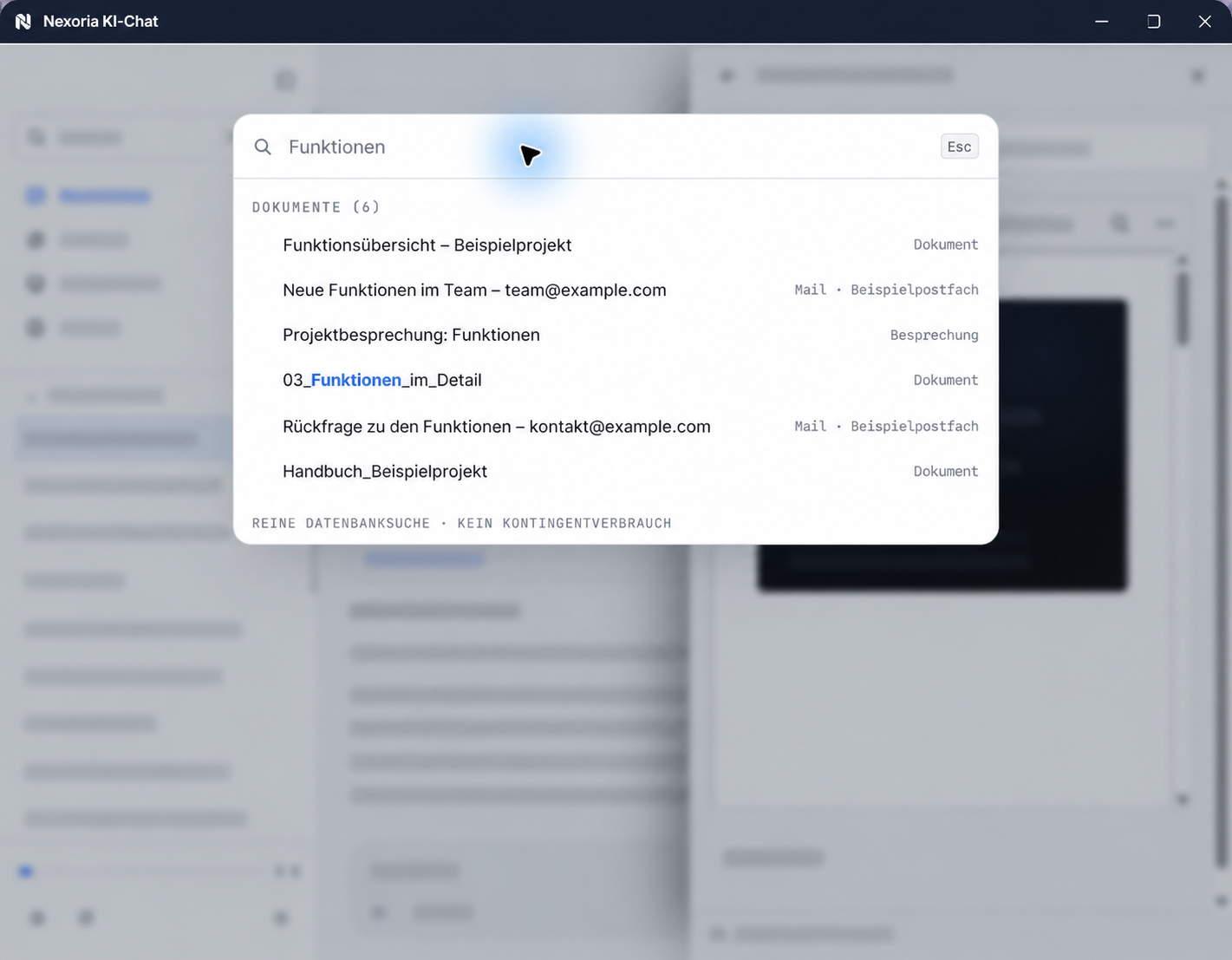
In Nexoria, Nexoria Drive, document search and the AI assistant Nex connect your own body of knowledge with everyday work. The document search with source citations supports finding information; Nex as an AI assistant supports working with answers and sources. The organisational implementation is described in Implementing knowledge management in a company.
Comparing providers: eight questions for an informed decision
Ask for the answers for the plan on offer and your planned configuration. This way, you compare concrete services and documented terms.
| Question | What to record for your selection |
|---|---|
| Which task should the AI take on? | An example from your business and the expected work result |
| Which information does it use? | Documents, connected systems and any additional knowledge sources used |
| Where is data stored and processed? | Consider file storage, search, model requests and other services separately |
| Who gets access to which content? | Roles, permissions and a test with different user accounts |
| How can an answer be traced? | Sources, document version and subject-matter review using your own test questions |
| How are inputs and outputs handled? | Use for training, retention, deletion and the related settings |
| Which documents and responsibilities are provided for? | Contacts, scope of services and the contractual and data protection documents relevant to your use |
| What makes up the total cost? | Licences, setup, usage and ongoing operation |
GDPR-compliant AI: what does the assessment involve?
Check the specific use, including the data, purposes, parties involved and settings. The German Data Protection Conference recommends considering selection, introduction and use together. Its guidance on AI and data protection provides checkpoints for this. Involve the people responsible for data protection and IT at an early stage.
For Nexoria, you will find information under Security and privacy. An overview of the individual processing steps is provided in Knowledge management with AI and data protection. In this context, the description of a storage location should be distinguished from processing by a connected AI service.
Nexoria: connecting company knowledge and daily work
Nexoria is a European work platform. Its core is formed by its own knowledge store with Nexoria Drive, document search and the AI assistant Nex. Built on this are Nexoria Office with Doc, Calc and Slides, Documents in Nex, Workspaces, text recognition, transcription, tasks, chatbots and configurable automations. Nexoria Mail, Nexoria Meet and the VoiceBot complement the platform as optional add-ons.
This lets you test your choice on a connected workflow: providing documents, finding information, checking an answer with its sources and using the result in further work. The range of features is shown in the Nexoria platform overview.
Example of a pilot: Your team compiles the approved product documentation for a product family. It asks about variants and operating conditions, opens the cited sources and records which answers are suitable for day-to-day advice. Qualitative example scenario, not a specific reference customer and no measured results.Include existing systems
SharePoint, OneDrive and Google Drive can be connected as knowledge sources on request. We set up the integration depending on your environment and permissions. On request, we also check integrations with further storage, CRM, ERP and own systems. Scope, updates and permissions are defined for each integration.
Discuss your starting point via Interfaces and integrations. For choosing a cross-system search, you can also read Choosing enterprise search solutions.
Consider data flows to suit the use
Files and the knowledge index are stored on servers in Germany, where search also runs. By default, Nex's answers are generated by Mistral AI. ChatGPT, Claude, Gemini and Langdock can optionally be included via your own provider account and a Nexoria MCP integration. In that case, the terms, processing locations and settings of the respective provider apply. Nexoria also works without these integrations.
Introducing AI in a company: start with a concrete task
1. Choose a use case. Name the recurring task, the people involved and the desired result. A manageable set of documents with clear subject-matter ownership is well suited to the first pilot. 2. Prepare data and access. Compile current documents. Agree who may use which content and who maintains changes to the document set. 3. Define the test in advance. Collect typical questions together with the expected sources. Check answers, matching passages and access separately. Record the initial state if you want to compare the effort later. 4. Involve the team. Show how data and results are to be handled. Plan the briefing and responsibilities to match the tasks of the employees. Guidance on AI literacy is provided by the European Commission. 5. Evaluate and expand together. Discuss the result with the subject-matter owners and decide which adjustments make sense before the next area of use.You will find the practical preparation in the guide Introducing AI knowledge search. The test log for your AI pilot supports documentation.
Frequently asked questions
Which AI is best for businesses?
The right choice depends on your task, the data required and the working environment. Compare candidates using the same test questions and assess result quality, sources, access, setup and costs. The tool overview on this page helps with shortlisting.
How can I use AI for my business?
Start with a recurring task, such as finding information in product documentation or preparing a text from approved information. Set a subject-matter goal, choose a suitable tool and test it with a small team. The section on introducing AI describes the steps.
What are some examples of AI in business?
One possible example is preparing a customer reply based on approved product documentation. Another is a summary of selected project information for a handover. These are qualitative example scenarios, not customer references or measured results.
Can an AI work with our own documents?
Yes. Applications with document access can search for relevant content and draw on it for an answer. In Nexoria, the knowledge store, document search and Nex form this workflow. In the pilot, check the documents used and the associated sources.
Do I need to train a language model on our documents?
A search-based approach does not require additional model training. With RAG, relevant information from a document set is provided for each request. Whether inputs are subsequently used for other purposes is a separate question of the respective provider's terms and settings.
How can scattered company knowledge be made usable?
First define which content is relevant for the planned use. Nexoria connects its own knowledge store with search and Nex; existing storage can be connected by arrangement. Clarify the scope, updates and permissions for each integration.
Are there AI answers with sources from my documents?
Nex supports answers with source citations based on company knowledge. Use the sources for subject-matter review and take the document version into account. In the test, define which content is relevant for each question.
Which AI tool is GDPR-compliant?
Assess the intended use, the data processing and the contractual terms together. The provider questions on this page and the linked guidance from the German Data Protection Conference support your selection. The assessment relates to your specific application and configuration.
When does the GDPR need to be considered when using AI?
If personal data is processed, the data protection requirements that apply to it must be checked. Consider inputs, account data and outputs. The guidance from the German Data Protection Conference explains this assessment for AI applications.
Is ChatGPT or Copilot suitable for our company?
Check the plan, the working environment, the data sources and the contractual terms for your use. The pages ChatGPT Enterprise comparison and Microsoft Copilot comparison support a more precise selection.
Where is data processed and is it used for training?
Distinguish between file storage, search and answer generation. For Nexoria, files and the knowledge index are on servers in Germany; by default, Nex uses Mistral AI for answer generation. Check use for training and retention for each service against the applicable terms and account settings.
How much does AI cost for a team?
Compare the scope of services you need, the setup and ongoing use. For Nexoria, you can find plans and add-ons under Pricing and scope of services. Setup is agreed depending on the project and the work involved.
What does sovereign AI mean for your selection?
Translate the term into concrete criteria: who manages access and data, which providers are involved, how can information be reused and how can you switch services? Ask for these points to be explained and documented for your planned use.
What are AI agents?
AI agents can control their own process and their use of tools to complete a task. Predefined AI workflows, by contrast, follow fixed steps. When choosing, the specific actions, permissions and approvals of the respective product are therefore what matter. Arrange a test based on your workflow.
Your next step
Let's discuss which task Nexoria should take on in your company. Together, we look at your body of knowledge, the systems involved and a suitable starting point.
Discuss Nexoria for your companySources and further information
External sources checked on 29 September 2026. The tool overview and the pilot steps are an editorial assessment to support provider selection.
- BSI: Generative AI Models: technical explanation of terms.
- Anthropic: Building Effective Agents: distinguishing agents from predefined workflows.
- Lewis et al.: Retrieval-Augmented Generation: search context and answer generation.
- German Data Protection Conference: Artificial Intelligence and Data Protection: selection and use of AI applications.
- European Commission: Questions on AI literacy: context on AI literacy in companies.