


This glossary explains seven terms that come up constantly in tenders, data protection reviews and conversations with providers, and that are often meant in different ways. Each page begins with a neutral definition, states the origin and the relevant standards, and describes how it works and the common methods. Only after that does it say how Nexoria implements the term.
What this glossary is for
Anyone looking up a term wants an explanation, not a product. That is why the explanatory part of every page here is complete before Nexoria is even mentioned. If you read the sections on definition, origin, how it works and methods and skip the rest, you have an answer that applies to any other provider as well. That is exactly the difference between a glossary entry and a sales page with a term as its heading.
If you need an assessment of your own content rather than a definition, you will reach your goal faster via Contact than via this page. The glossary answers what a term means, not what it means in your organisation.
The second part of each page then places the term in concrete context: what Nexoria does at this point and with which components. You can find detailed information on processing, hosting and data protection under Security and privacy.
Why these seven terms in particular
A glossary can be extended indefinitely. Every additional term is another URL, and a collection of forty superficial definitions looks good in the page count but not in substance. That is why this glossary only includes terms to which Nexoria can contribute its own expertise: either because the platform uses the method itself, or because the question comes up in every procurement conversation.
- Included if Nexoria uses the term in its own operations or has to comment on it in a review.
- Not included if, without reference to the product, the page would merely repeat a dictionary definition that is better covered elsewhere.
- No minimum length. A term that is explained in five paragraphs gets five paragraphs.
Each page cites its sources and, where available, the underlying standards.
Knowledge, search and methods
These five terms are connected: company knowledge is the subject, AI knowledge management the task, enterprise search the application, semantic document search the search method and RAG the architecture that turns it into an answer.
- Company knowledgeThe knowledge of an organisation as a whole, documented in files and unwritten in the minds of its employees.
- AI knowledge managementThe use of AI methods in an organisation's knowledge management, in making knowledge accessible, finding it and passing it on.
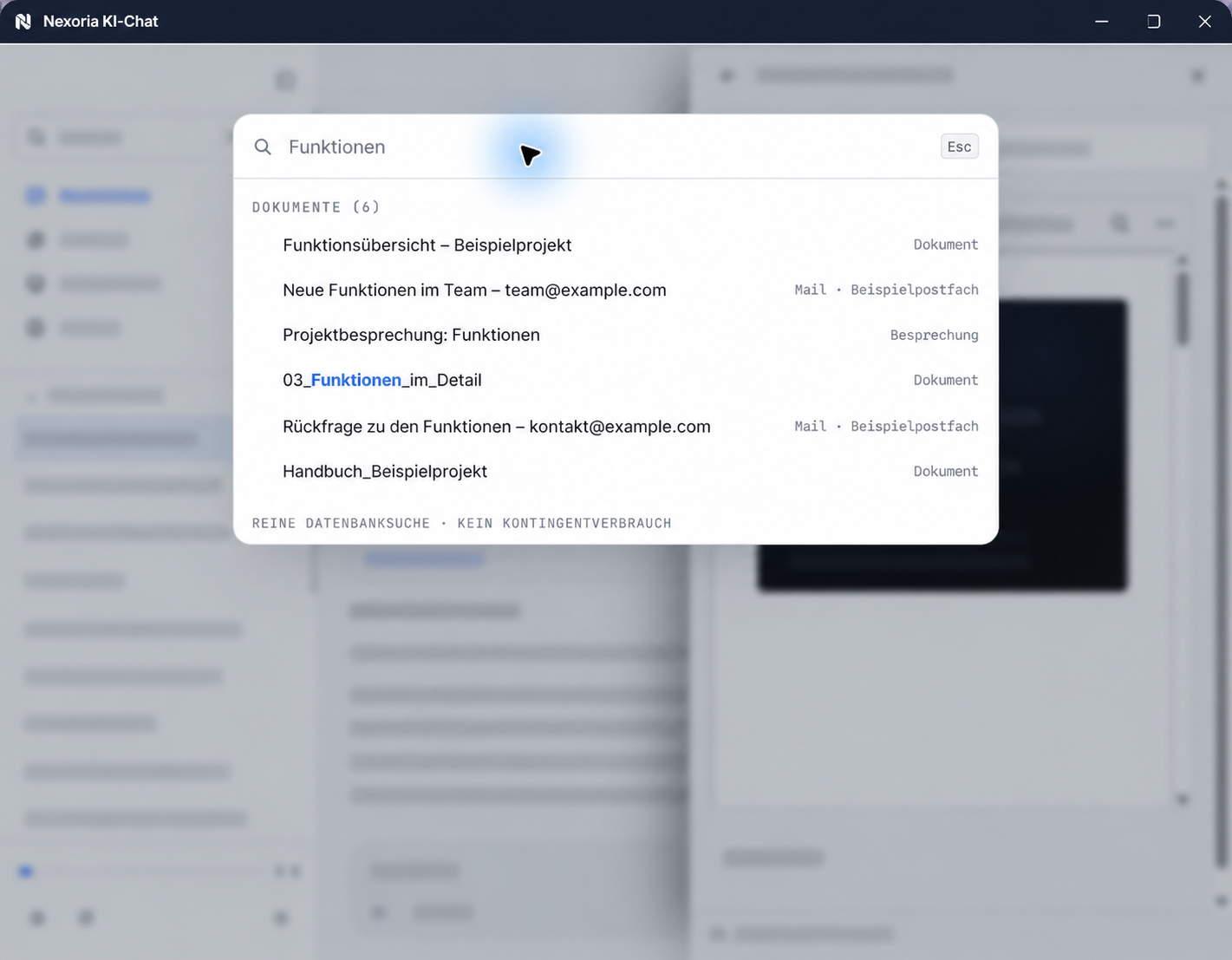
- Enterprise SearchSearch within an organisation's closed body of information, with a permission check on every query.
- Semantic document searchSearch by meaning rather than by character string, technically via embeddings and distances in a vector space.
- RAG (Retrieval Augmented Generation)An architecture in which a language model searches first and then answers from the passages it found.
Location and control of data
These two terms are often treated as the same in sales, but they mean different things. One answers a question of location, the other a question of access and law.
If you are looking for an answer, not a definition
The glossary explains terms. The practical questions behind them have their own pages: how scattered files become usable company knowledge, how company documents can be searched semantically and what cloud storage has to provide in addition so that AI can use it. The individual components of the platform can be found under Product, and information on processing and security under Security.
As of