


AI knowledge management refers to the use of AI methods within an organisation's knowledge management, that is, in capturing, organising, finding and passing on knowledge. Typically, the manual maintenance of categories and keyword tagging is supplemented or replaced by machine indexing and semantic search. The term itself comes from market parlance and is not standardised. Only knowledge management itself is standardised, in ISO 30401, and this standard describes a management system, not a technology.
Where the term comes from and where it is standardised
Knowledge management is a business discipline that has established itself as a field in its own right since the 1990s. Since 2018, there has been an international management system standard for it, ISO 30401. It sets requirements for an organisation's knowledge management system: context and stakeholders, leadership responsibility, objectives, resources, evaluation and improvement. It is structured in the same way as other management system standards and is aimed at the organisation, not at a product.
The qualifier AI does not come from the standard. It indicates that subtasks of knowledge management are carried out with machine methods, in particular with language models and with search methods based on learned vector representations. For the architecture in which a language model answers based on a defined document collection, there is a primary source: the paper by Lewis and others from 2020. For the compound term AI knowledge management, there is none.
Putting the term in context
AI knowledge management is a term from market parlance. Knowledge management itself is standardised, in ISO 30401, as a management system. Which technology an offering uses is shown in its detailed description.
What AI takes on in knowledge management
Knowledge management can be broken down into four recurring activities. Machine methods come into play at a different point in each of them.
- Capturing: Content that exists only as an image or audio recording is converted into text. Text recognition and transcription thus open up collections that were previously invisible to any search.
- Organising: Instead of manually maintained keyword tagging, vector representations of the text passages are created. The order is then no longer visible; it lies in the distances. This saves maintenance effort.
- Finding: The search is based on meaning rather than character strings. Anyone who does not know the wording used in the document will still find the passage.
- Passing on: Several source passages are turned into a written answer with a source reference, instead of a list of results that someone still has to read.
The real gain does not lie in any one of these four activities but in the shift in costs: looking something up becomes cheaper than asking. That is exactly when a collection stops being a dead archive. The prerequisite is that the content is stored.
What approaches and providers exist
There are three architectures on the market that differ significantly in effort and control.
- Add-on layer for existing tools: The existing wiki, file system or document management stays in place, and an AI function is added. Little migration effort, but the collection remains as scattered as it is.
- Integrated platform: Storage, index, search and assistant come from one provider. Fewer interfaces, uniform permission checks and one point of contact for storage, search and assistant.
- In-house build: Vector database, embedding model and language model are assembled in-house. Full control over every component, but ongoing operation, including updates and permission checks, also stays in-house.
Cutting across these three architectures is the question of where the processes run. Computing the vector representations and generating answers are two separate steps that can take place in different locations and with different providers. Anyone using AI for knowledge management should know both locations, see Data residency.
How Nexoria implements this
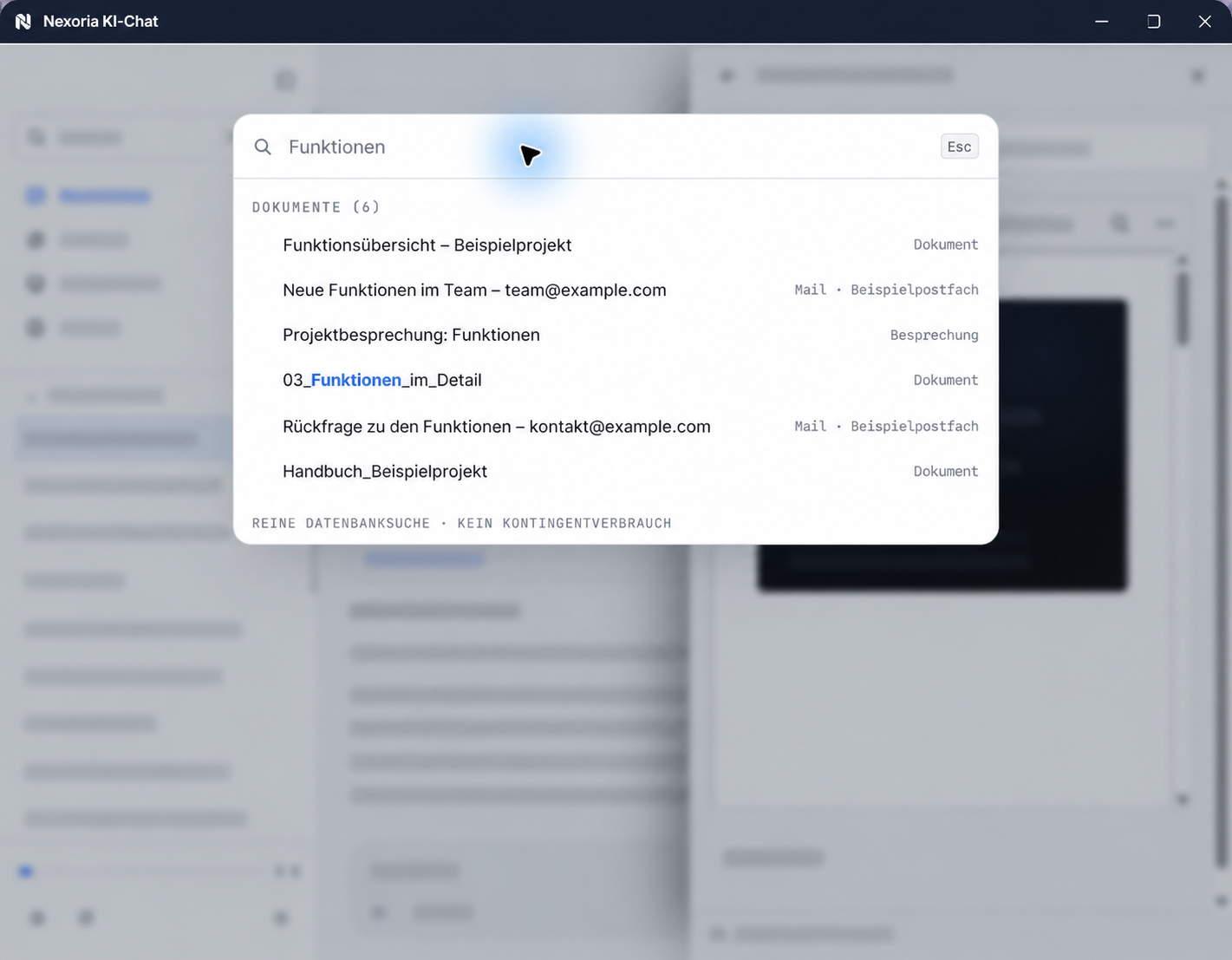
Nexoria positions itself as AI knowledge management on a company's own data. This is implemented as an integrated platform: the files are stored in Nexoria Drive, their content is indexed when they are stored, and Speech and text recognition also makes recordings, scans and images accessible. Searching is done with Document search, and content is retrieved and processed further via the assistant Nex. Workspaces determine who can access what.
As for what happens to the content: In Nexoria’s verified Mistral organisation, the use of new API interactions for model training is disabled (account checked on 26 September 2026). This setting applies to new interactions processed there. For your own optionally connected AI accounts, the settings of the respective account apply.
Tool and organisation working together
The tasks and prerequisites you should clarify before getting started are described in AI for business.
- Nexoria is the tool you use to make stored knowledge accessible, find it and pass it on. You define roles, responsibilities, objectives and their evaluation within the meaning of ISO 30401 in your organisation. Certification under this standard applies to your organisation's management system, not to the software used.
- What gets indexed is whatever is stored in Nexoria Drive and shared for the relevant workspace. Experiential knowledge that your team writes down and stores there therefore becomes searchable as well.
- The semantic search determines which passages match a question based on meaning rather than individual words. Document search names the source for every result, so you can check each passage directly in the document.
Sources
As of
- ISO 30401:2018, Knowledge management systems, Requirements. International Organization for Standardization (ISO), 2018. https://www.iso.org/standard/68683.html Retrieved on .The management system standard for knowledge management. It describes requirements for a management system, not for software, and uses the term organizational knowledge. The full text is subject to a charge; the linked page gives the title, edition and scope.
- Lewis et al., Retrieval-Augmented Generation for Knowledge-Intensive NLP Tasks. Advances in Neural Information Processing Systems 33 (NeurIPS 2020), preprint on arXiv, 2020. https://arxiv.org/abs/2005.11401 Retrieved on .The first description of the RAG method. It introduces the name and describes the combination of a retrieval step with a generative model.
As of